Iranian American Civic Engagement: Why the Stakes Have Never Been Higher
- Brian Taef
- May 26
- 7 min read
The Iranian-American community is one of the most educated, entrepreneurial, and freedom-tested populations in the United States. Yet civic disengagement remains widespread. Here is why that must change, and how to start.

There is a quiet paradox at the heart of the Iranian-American experience.
We are a community that fled censorship, state repression, and the systematic removal of political rights. We know, in our bones, in our family stories, in the memories we carry across oceans, what it looks like when a government silences its people. And yet, once we arrive in a country that guarantees the right to vote, to organize, and to speak freely, millions of us choose not to use those rights.
That silence is not apathy. It is complicated. It is the exhaustion of rebuilding a life from scratch. It is the distrust of political systems earned through painful experience. It is the feeling of being caught between two worlds, belonging fully to neither. It is the sense that one vote, one voice, one community cannot possibly matter in a country of 350 million.
We understand all of that. And we are here to tell you, respectfully and urgently, that it is time to set it aside.
WHO IRANIAN AMERICANS ARE, AND THE POWER WE ARE NOT USING
The Iranian-American community is remarkable by any measure. According to research from the Iranian Studies Group and multiple U.S. demographic surveys, Iranian Americans consistently rank among the most highly educated immigrant communities in the United States, with rates of graduate and professional degrees that exceed the national average by a significant margin. The community has produced scientists, surgeons, engineers, artists, entrepreneurs, and academics who have shaped American life in every field.
A few numbers worth knowing:
- Approximately 1.5 million Iranian Americans live in the United States.
- More than 40 percent hold advanced degrees, far above the national average.
- An estimated 800,000 Iranian Americans are eligible to vote.
- Voter turnout within the community remains low relative to its size and civic potential.
That gap, between what this community is capable of and what it currently does civically, is not just a missed opportunity. It is a problem with real consequences.
When a community that understands the value of freedom better than almost anyone chooses silence, it does not stay neutral. It cedes ground.
WHY CIVIC DISENGAGEMENT HAS ROOTS, AND WHY WE MUST GROW PAST THEM
It would be dishonest to demand civic participation without acknowledging why so many Iranian Americans hold back. Many in the first generation arrived in the United States after the 1979 revolution, a moment when political participation in Iran ended in betrayal, imprisonment, or death for those who trusted the wrong movement. That lesson does not simply evaporate when you cross an ocean.
There is also the experience of being misunderstood in America, of watching political discourse reduce Iran to a nuclear threat or a foreign policy problem, with little room for the richness of Persian culture, the diversity of Iranian political opinion, or the humanity of the diaspora. When neither political party seems to see you clearly, disengagement can feel like the only honest response.
And for second-generation Iranian Americans, those who grew up between Nowruz and Thanksgiving, between Hafez and Halloween, there is often a different barrier: the question of identity itself. Am I Iranian enough to speak for this community? Am I American enough to participate in its politics? The answer to both is yes. But it takes community and encouragement to believe it, and more importantly to act on it.
We name these barriers not to excuse inaction, but because real civic engagement begins with honesty. The first step is understanding why we have been standing on the sidelines, and choosing to step onto the field anyway.
WHAT IS AT STAKE FOR THE IRANIAN-AMERICAN COMMUNITY
Civic engagement is not an abstract virtue. For the Iranian-American community, the stakes are concrete and immediate.
U.S. foreign policy toward Iran, including sanctions, diplomatic relations, and how America responds to the Iranian government's treatment of its own people, is shaped by elected officials. Elected officials respond to voters. When Iranian Americans are absent from the electorate, there is no political cost to ignoring the community's perspective. When Iranian Americans are engaged and organized, that calculus changes.
Immigration policy affects Iranian Americans directly. Travel bans, visa restrictions, green card backlogs, asylum processes, these are not distant policy abstractions. They are the difference between a family being reunited or separated, between a talented student getting a visa or being turned away. We understand that some restrictions exist for legitimate national security reasons, and we do not dismiss that. What we do believe is that these policies deserve honest, informed debate, and that debate only happens when the communities most affected by them show up, vote, and make their voices heard. These are decisions made by people who run for office, and who can be voted out of office.
Cultural representation and civil rights matter in a community that has sometimes faced discrimination and misrepresentation in the years following 9/11 and during periods of heightened U.S.-Iran tensions. Political engagement is how communities protect themselves. It is how you ensure that the next time a politician generalizes about Iranians, there is a cost, because there are Iranian-American voters paying attention.
The freedom movement inside Iran, the brave women and men risking their lives for a future without the Islamic Republic, needs allies in the democratic world. The most powerful thing the Iranian diaspora can do for those people is to be politically engaged in the countries where we live. Our voice in American democracy is one of the few concrete tools we have to support the struggle for freedom in our ancestral homeland.
CIVIC ENGAGEMENT IS MORE THAN VOTING, BUT VOTING MATTERS ENORMOUSLY
When we talk about civic engagement, we mean something broader than showing up to a polling place every four years. We mean:
1. Voter registration and turnout
The foundation. If you are a U.S. citizen and not registered, register today. If you are registered, vote in every election, federal, state, and local. Local elections, in particular, are where small numbers of engaged voters have outsized impact.
2. Staying informed on the issues
Civic engagement means knowing what candidates and elected officials actually stand for, not just party labels. It means following policy developments that affect your community and holding elected officials accountable for their positions.
3. Community organizing and coalition-building
One vote matters. One hundred votes in a city council race can decide the outcome. One organized, engaged, and vocal community can change what politicians are willing to do. Iranian Americans are not a tiny group. We are geographically concentrated in places like California, Texas, New York, and Virginia, where organized civic action can genuinely move the needle.
4. Running for office and seeking civic leadership
The ultimate form of civic participation. Iranian Americans should be on city councils, school boards, state legislatures, and in federal office. Representation is not a luxury. It is the mechanism through which communities gain real political power.
5. Telling our stories in the public square
Media, social media, community events, op-eds, podcasts. The Iranian-American story is one of the most compelling and underrepresented narratives in American public life. Sharing it is a form of civic power.
THE LEGACY OF CYRUS, AND THE RESPONSIBILITY IT CARRIES
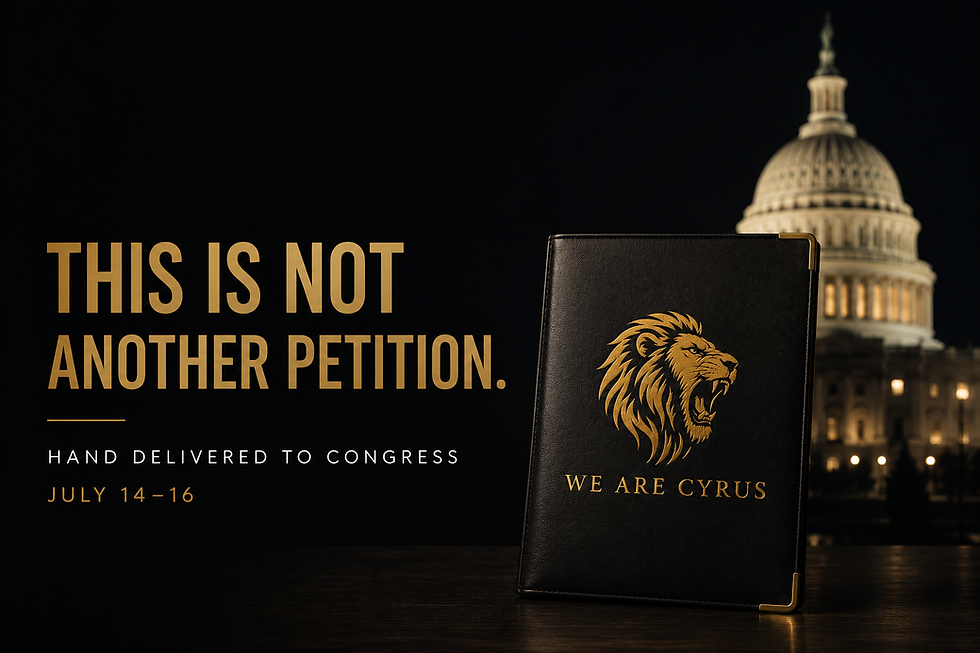
We are Cyrus. The name is not just a symbol. It is a standard.
Cyrus the Great, the Persian king who issued what many historians consider one of the first declarations of human rights, did not simply inherit a kingdom. He built a civilization on principles: that conquered peoples deserved dignity, that religious freedom was not a threat but a foundation, that good governance required mercy as much as strength. He is revered in the Hebrew Bible. He is the figure behind the Cyrus Cylinder, often called the first human rights charter, housed today in the British Museum.
To invoke Cyrus is to accept a responsibility. It is to say: we come from a people who understood freedom deeply enough to codify it. We have a particular obligation to defend it, here, in our adopted country, and everywhere.
That responsibility does not live only in memory and heritage. It lives in action. It lives in the decision to register, to vote, to organize, to lead, to speak, even when it is inconvenient, even when you feel like an outsider, even when the political system feels broken.
Because here is what we know about broken systems: they do not repair themselves. People repair them. Communities repair them. Voters repair them.
We come from a people who understood freedom deeply enough to codify it. We have a particular obligation to defend it.
A MESSAGE TO THE FIRST GENERATION
If you came to this country after fleeing the Islamic Republic, after losing your career, your home, your community, or your freedom, you may feel that American politics has little to do with you. You worked hard. You rebuilt. You gave your children what you could not have. That is extraordinary, and it is enough.
But we ask you to consider one more thing. The freedom you found here is not self-sustaining. It requires maintenance, and that maintenance is called participation. Every naturalized citizen who registers and votes is doing something that millions of people in Iran cannot do. That is not nothing. That is everything.
A MESSAGE TO THE SECOND GENERATION
You grew up between two worlds. You may have felt, at different moments, too Iranian for America and too American for Iran. That in-between place, uncomfortable as it has sometimes been, is actually a position of strength. You understand both worlds. You can build bridges that others cannot.
The Iranian-American political voice of the next decade will be shaped by people like you. The question is whether you will be in the room when it happens, or whether you will look back and wonder why you sat it out.
A MESSAGE TO OUR ALLIES
If you are not Iranian American but you believe in freedom, civic participation, and the dignity of immigrant communities, you belong in this movement too. Cyrus the Great included everyone in his conception of a just society. So do we.
Stand with the Iranian-American community. Amplify its stories. Support its candidates and organizations. And vote, every chance you get, for the values that make a free society worth living in.
HOW TO GET INVOLVED WITH WE ARE CYRUS
We Are Cyrus is a growing movement dedicated to Iranian-American civic engagement, voter awareness, community building, and leadership development. Whether you are newly naturalized, a longtime citizen, a young Iranian American finding your political voice, or an ally to the community, there is a place for you here.
We offer resources on voter registration, information on candidates and policies affecting the Iranian-American community, storytelling platforms to share your experience, and a growing network of civically engaged Iranian Americans across the United States.
The story of our people did not end in exile. It is being written right now, in ballot boxes, in community meetings, in op-ed pages, in city councils, and in the lives of every Iranian American who decides that freedom is worth showing up for.
Register. Get involved. Make your voice heard. The Iranian-American community has earned its seat at the table. Now it is time to take it.
Visit us at wearecyrus.com.


Comments